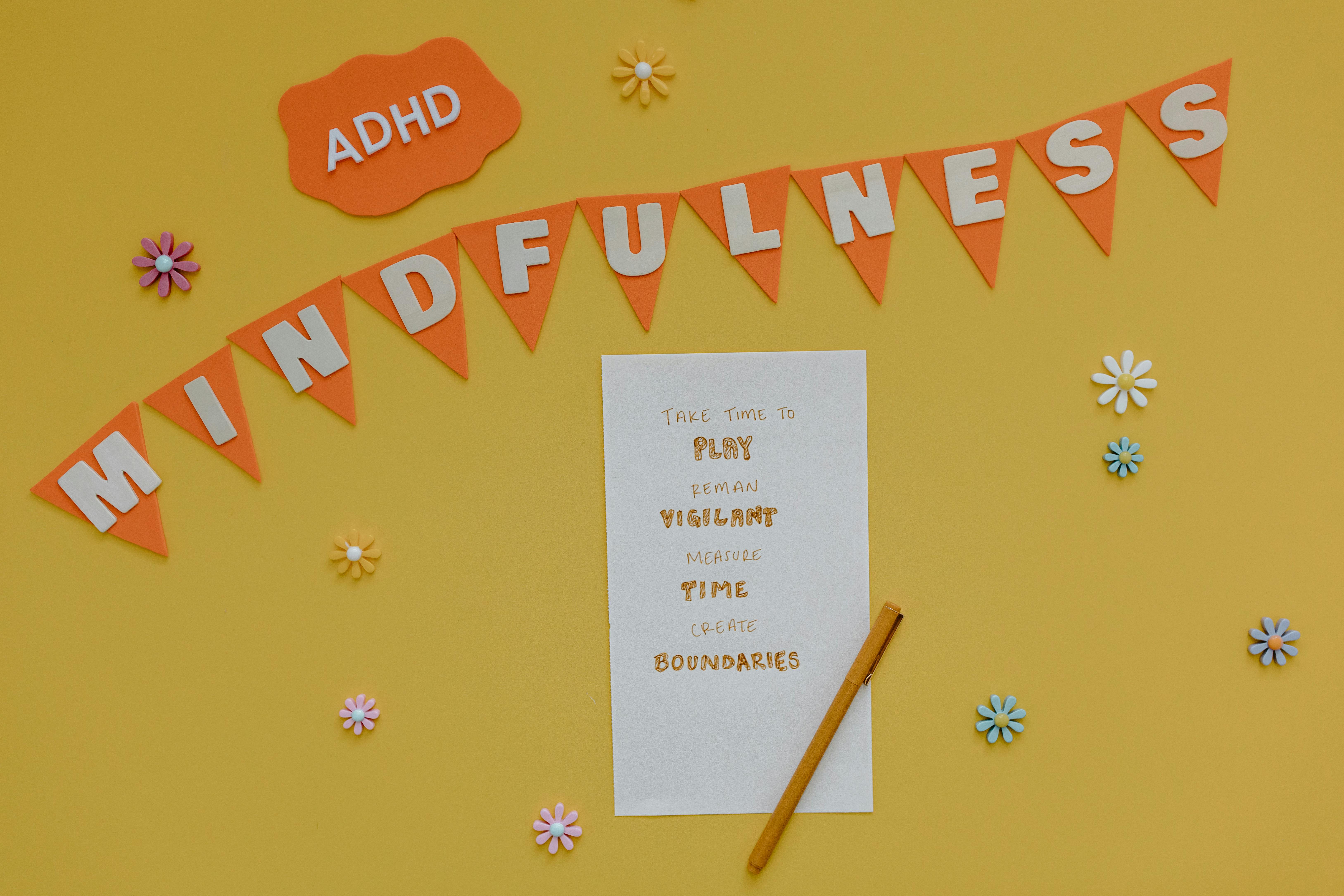
If you have ADHD, you have probably heard "just take a deep breath" or "practice self-care" more times than you can count. It lands wrong because the advice is not wrong. It is missing the step where your brain is wired to feel things at full volume before you even register what happened. Emotional regulation is not about controlling your feelings. It is about building a system that catches you before the wave pulls you under.
These eight strategies are not generic wellness tips. They are designed specifically for ADHD brains, where working memory is unreliable, time blindness distorts recovery, and emotional intensity arrives without warning. Each one accounts for a real neural barrier and offers a concrete way around it.
Photo: Tara Winstead / Pexels
Why Standard Self-Care Advice Does Not Work for ADHD
Standard self-care advice assumes your brain processes emotions on a predictable curve: you feel something, you process it, you move on. For ADHD brains, the curve is steeper and longer. A minor frustration at 10 a.m. can derail the entire afternoon, not because you are dramatic but because the emotional signal does not fade the way it does in neurotypical brains.
Research from Russell Barkley (2015) in the Journal of Attention Disorders and a 2020 meta-analysis in Clinical Psychology Review both identify emotional dysregulation as a core feature of ADHD, not a secondary symptom. It is tied to the same executive dysfunction that affects focus and impulse control. Our guide to understanding emotional dysregulation in ADHD covers the neuroscience in more depth. Telling someone with ADHD to "just breathe through it" ignores that the brake pedal is loose. You need a different kind of strategy, one that works with the hardware you have.
Reality Check
"Take a bubble bath" is not self-care for an ADHD brain that cannot transition out of hyperfocus, cannot sit still long enough to relax, and then feels guilty for failing at relaxing too.
The Strategies
1. Catch It Before It Peaks
Most emotional regulation advice focuses on what to do once you are already flooded. That is too late. By the time you feel the heat in your chest or the knot in your stomach, your prefrontal cortex is partially offline and you are running on limbic system alone.
Instead, train yourself to notice the early signals. Maybe your shoulders go up. Maybe your jaw tightens. Maybe your self-talk shifts into absolutist language ("always," "never," "everyone"). Pick one physical cue and one cognitive cue that signal escalation for you. When you notice either, pause for three seconds. Just three. That small gap is enough to interrupt the automatic spiral before it reaches full intensity.
2. Name It To Tame It
Emotional intensity feeds on vagueness. "I feel terrible" is an unreachable problem. "I feel blindsided and embarrassed because I interrupted my colleague in a meeting" is something you can work with.
When you notice a strong emotion, label it in one sentence: "I feel [emotion] because [trigger]." Say it out loud or write it down. The act of naming moves activation from the amygdala to the prefrontal cortex. It does not make the feeling disappear, but it shrinks it from an overwhelming fog to a manageable problem. For more techniques, see our practical tools for managing emotional dysregulation.
3. Build a Five-Minute Reset
Your brain needs a structured way to disengage from an emotional trigger. Without one, it cycles. A five-minute reset is a pre-decided sequence you can run without thinking.
Example: Step away from the trigger (physically leave the room). Splash cold water on your face or run your wrists under cold tap water. Take five slow breaths, counting four seconds in and six seconds out. Return to what you were doing. No journaling, no analysis, no processing: just a hard reset. Your working memory cannot handle a complex coping sequence when you are dysregulated, so make it simple enough that you can execute it on autopilot.
4. Use a Self-Care Menu Instead of a Routine
Routines fail for ADHD brains because they depend on consistency, habit recall, and exactly the executive functions that are compromised during emotional dysregulation. A self-care menu solves this: a written list of 10 to 15 options divided by energy level.
When you feel the spiral starting, glance at the menu and pick one thing from your current energy tier. High energy options might include a 20-minute walk or reorganizing a small drawer. Low energy options might include lying on the floor with headphones on for five minutes or drinking a glass of water while staring out a window. The menu removes the decision burden when your brain is least equipped to decide. Our self-care strategies guide has more ideas for building a practice that actually fits.
If you have tried building a self-care practice and keep hitting walls where your brain simply will not cooperate, that is not a personal failure. ADHD-informed providers understand why standard advice does not stick and can help you build approaches that actually fit. The directory lets you filter by specialization and location.
Find a Provider5. Schedule Emotional Recovery Time
Emotional dysregulation is exhausting. A five-minute argument or a tense email can drain the same energy as an hour of focused work. Most people do not account for this recovery cost in their day, so they wonder why they crash by 3 p.m.
Build 15-minute recovery buffers into your schedule after known emotional triggers. If you have a difficult meeting at 10, block 10:15 to 10:30 as transition time. No calls, no decisions, no deep work. Scroll your phone. Stare at a wall. Let your nervous system settle before you ask it to perform again.
6. Separate the Feeling From the Decision
ADHD brains are prone to what researchers call "urgency-based decision-making." When an emotion is strong, the brain treats it as a signal that action is required immediately. Most of the time it is not.
When you feel a strong urge to act on an emotion (send that email, quit that project, have that conversation right now), externalize the decision. Write it down and set a timer for 20 minutes. When the timer goes off, decide again. The emotion will still be there, but the urgency will have faded enough that your prefrontal cortex can weigh in. You can still send the email or have the conversation. You just wait long enough to make the decision you will not regret.
7. Use the 10 Percent Rule for Self-Care
Many ADHD adults set ambitious self-care goals (exercise daily, meditate 20 minutes, sleep eight hours) and then feel shame when they inevitably miss a day. That shame kills the whole practice. The 10 percent rule says: set the goal at 10 percent of what you think you should do. Meditate for two minutes instead of 20. Walk around the block instead of the trail. Wash your face instead of a full skincare routine.
The point is not the duration. The point is that you did it. Consistency at low intensity builds the neural pathway for self-care. You can increase the duration later, but the habit has to exist first.
8. Give Yourself Permission to Disengage
When you are emotionally flooded and none of the other strategies are working, the move is not to push harder. It is to disengage with permission. Say to yourself: "I am done with this for today. I will deal with it tomorrow." And actually mean it.
The hardest part of emotional regulation for ADHD brains is not the feeling itself. It is the self-criticism that follows. "I should be able to handle this. Everyone else handles this. What is wrong with me?" That second layer of emotion multiplies the original feeling and extends the recovery time. Permission to step away intercepts that second layer. You can come back tomorrow with a regulated brain and solve the problem in half the time it would take today.
Which Strategy Fits Your Situation
| If you tend to... | Try this first |
|---|---|
| get flooded before you even notice what happened | Strategy 1: Catch It Before It Peaks |
| feel overwhelmed by vague, unnamed emotions | Strategy 2: Name It To Tame It |
| get stuck cycling on a trigger without relief | Strategy 3: Build a Five-Minute Reset |
| struggle to choose what to do when upset | Strategy 4: Use a Self-Care Menu Instead of a Routine |
| crash hard after emotional events | Strategy 5: Schedule Emotional Recovery Time |
| impulsively act on strong emotions | Strategy 6: Separate the Feeling From the Decision |
| feel shame about not doing enough for yourself | Strategy 7: Use the 10 Percent Rule for Self-Care |
| lose entire days to emotional spirals | Strategy 8: Give Yourself Permission to Disengage |
How to Actually Stick With One
Pick one strategy from the table above that matches your most common pattern. Not the one you think you should use. The one that made you think, "that is exactly what I do." Use it for two weeks before adding another. If you forget for three days in a row, start again without the shame spiral. Forgetting is part of having an ADHD brain. It does not mean the strategy does not work. It means you need a reminder system: a note on your phone lock screen, a sticky note on your monitor, an alarm labeled "check-in."
Warning
Trying all eight strategies at once is a guaranteed path to burnout. Choose one. Two weeks. Then decide.
What to Do When Nothing Clicks
If you have tried strategies like these and they still do not seem to move the needle, it is worth checking what else is under the hood. Chronic emotional dysregulation can be worsened by untreated anxiety, depression, or sleep disorders, all of which are common with ADHD. Our guide on the link between ADHD and depression covers how these conditions interact. It can also signal that your ADHD medication or dosage is not quite right. Emotional regulation improvements are one of the most commonly reported benefits of well-titrated ADHD treatment, so difficulty regulating emotions can be a signal worth bringing to your prescriber. If you are experiencing ADHD burnout, that may also be contributing to the intensity of your emotional responses.
A therapist who specializes in ADHD can also help. Approaches like CBT adapted for ADHD and DBT for emotional regulation have solid evidence behind them (a 2022 review in BMC Psychiatry found DBT skills training significantly improved emotional regulation in adults with ADHD). Our directory includes providers across all 50 states who list emotional regulation as a specialty area.
Find a specialist: filter by location, insurance, and specialization.
Solution
If strategies alone are not enough, the next step is a conversation with an ADHD-informed therapist or prescriber about what is driving the dysregulation at its source.
Frequently Asked Questions
Is emotional dysregulation a symptom of ADHD?
Yes. Emotional dysregulation is considered a core feature of ADHD by many researchers, including Russell Barkley. It affects approximately 70 percent of adults with ADHD and is linked to the same executive function differences that affect attention and impulse control. It is not a separate disorder. It is part of how ADHD works.
Can self-care really help with ADHD emotional regulation?
Yes, but only when self-care is designed for how an ADHD brain actually works. Generic advice like "take a bath" or "meditate daily" fails because it assumes consistent executive function. ADHD-specific self-care strategies account for the barriers: low working memory, difficulty with transitions, emotional intensity. They build around them.
What is the fastest way to calm down from ADHD emotional flooding?
The five-minute reset (cold water, breathing, physical separation) is the fastest reliable method for most people. The key is to execute it before the spiral peaks, which means catching the early physical signals (tight jaw, rising shoulders, heat in the chest) and acting immediately.
Should I consider medication for emotional regulation?
Emotional regulation improvement is one of the most commonly reported benefits of properly titrated ADHD medication. If emotional dysregulation is a daily struggle that does not respond to strategies, it is worth discussing with a prescriber. Many adults find that once their core ADHD symptoms are treated, emotional intensity becomes more manageable.
How is ADHD emotional dysregulation different from bipolar disorder?
ADHD emotional dysregulation is triggered by events and resolves more quickly (minutes to hours). Bipolar mood episodes are longer-lasting (days to weeks) and can occur without an external trigger. A mental health professional can help distinguish between them. Misdiagnosis is common. Women with ADHD are sometimes incorrectly diagnosed with bipolar disorder before receiving an accurate ADHD diagnosis.
Pick One and Start
Start with Strategy 6 if you act on emotions impulsively. Start with Strategy 1 if the flood hits before you know what is happening. Start with Strategy 7 if shame about not doing enough is the loudest voice in your head. The goal is not to master all eight. The goal is to pick one, try it today, and see what happens. Success is trying it once.
Find a specialist: filter by location, insurance, and specialization.
Related: 9 ADHD Unmasking Strategies for Living More Authentically (2026)
Related: ADHD Rejection Sensitive Dysphoria: Why It Hurts So Much and What Helps
Related: How to Rest With ADHD: 8 Types of Rest That Actually Recharge You This article is for informational purposes only and is not a substitute for professional medical advice, diagnosis, or treatment. Always seek the guidance of a qualified healthcare provider with any questions you may have regarding a medical condition.